
Don’t Miss A Beat – Dont’t Miss A Heart
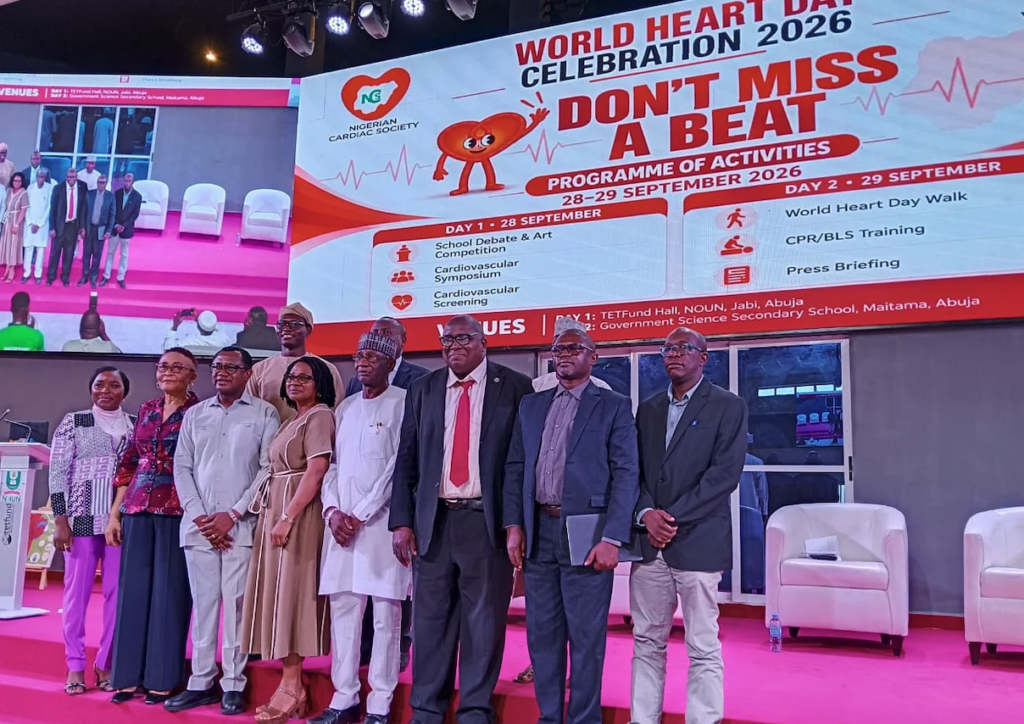
This year, Abuja, Nigeria served as the epicenter of World Heart Day, and perhaps nowhere could the message be more consequential, where I joined hands with VP- Prof. Amam Mbakwem.
The World Heart Federation had declared 2026 the Year of Neglected Cardiovascular Diseases: rheumatic heart disease, congenital heart disease, Chagas disease, inherited cardiomyopathies and aortopathies, conditions affecting an estimated 100 million people, yet too often left behind by the extraordinary progress of modern cardiovascular medicine. Diseases do not neglect people. We do. Neglect is not biology. It is a choice. And choices can be changed.
Africa lives at the intersection of two cardiovascular epidemics.
The unfinished burden of the neglected conditions remains enormous. Yet simultaneously, diseases considered to afflict affluent nations—hypertension, diabetes, obesity, dyslipidemia, atherosclerosis, coronary disease and stroke are increasing, often in younger populations and in health systems least equipped for their lifelong consequences.
The old diseases have not disappeared. The new ones have already arrived. That is the double burden we must confront.
For children born with congenital heart disease, our World Heart Report asks a fundamental question of equity: why should geography determine whether a repairable heart is repaired? For rheumatic heart disease, Africa provides the moral urgency. A childhood sore throat should never become heart failure in a young mother. Later this year, the global community will gather in Perth for the RHD Congress. The Perth Declaration must help carry us from recognition to implementation because a declaration is not a treatment. Penicillin is–a vaccine will be. A resolution cannot repair a valve–a functioning health system can.
And this year, our cardiovascular family must widen further.
At UNGA81, Nigeria helped launch OneSCD. Some 150,000 Nigerian babies are born with sickle cell disease each year. It begins in the blood, but its consequences reach the brain, lungs and heart, stroke, pulmonary hypertension, myocardial disease, arrhythmias, thrombosis and sudden death.
These children must belong to us too. Hematology remains their home. Cardiovascular medicine should become their second home. And hope can be surprisingly practical: A screening test. A scan. A tablet. Newborn screening. Transcranial Doppler. Hydroxyurea. Nigeria helped create the science; now we must get the science to every child who needs it.
But Africa’s cardiovascular future cannot be only about treating disease. We must prevent another epidemic from becoming entrenched. Economic and social transition must not inevitably bring more tobacco, unhealthy food, inactivity, obesity, hypertension, diabetes and premature cardiovascular disease. Development should buy health, not disease.
And let us change one more narrative. Nigeria and Africa should not be viewed simply as places where the burden is greatest. Let them become places where solutions begin and where ideas travel from Abuja, Kano and Lagos to the world. That, for me, is World Heart Day 2026.
Do not abandon the diseases we have neglected. Do not allow today’s transitions to become tomorrow’s cardiovascular epidemic. And do not accept that where a child is born determines whether that child lives.
Don’t miss a beat. Don’t miss a heart. Don’t leave anyone behind.