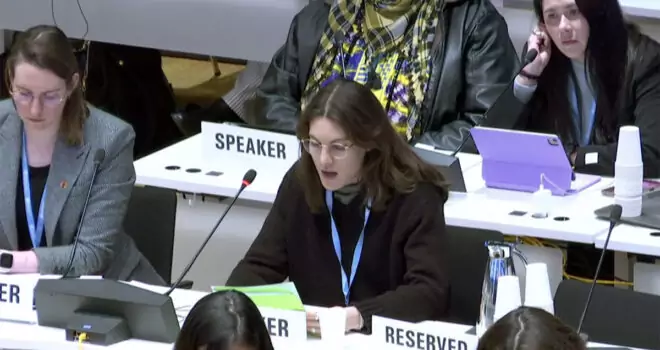
The World Heart Federation (WHF) actively represented the global cardiovascular community at the 158th session of the World Health Organization (WHO) Executive Board, which was held from 02 to 07 February 2026 in Geneva, Switzerland.
The WHF delegation, headed by Dr. Bente Mikkelsen, Chair of its Advocacy Committee, delivered a series of statements across multiple agenda items to ensure that cardiovascular health remains a global health priority. In particular, WHF led two constituency statements under agenda item 16 – WHO’s Work in Health Emergencies – and agenda item 23 – Well-Being and Health Promotion. Through its statements, WHF called on Member States to:
- Prioritize the needs of people living with noncommunicable diseases (NCDs), especially cardiovascular disease, in health emergencies and humanitarian settings, as well as integrate NCDs into the global health security agenda;
- Integrate essential NCD services into emergency preparedness, response, and recovery plans;
- Strengthen primary healthcare and universal health coverage as core emergency infrastructure to build resilient and inclusive systems that ensure continuous, integrated, people-centred, and equitable NCD prevention, treatment, and care, including through sustained investment in the health workforce as a critical enabler of service delivery, combined with mechanisms for financial protection and reduced barriers to care; and
- Collect, analyse, and use data to generate timely intelligence for humanitarian actors and health systems.
In the context of well-being and health promotion, WHF further urged Member States to address the social, commercial, economic, and environment determinants of health across the life course. WHF stressed that measures which protect public policy from conflicts of interest and prioritize public health over short-term profits were essential components of public health governance.
WHF also delivered an individual statement under agenda item 6 – Noncommunicable Diseases – with a specific focus on cardiovascular disease. WHF highlighted its five Key Policy Asks from the Fourth United Nations High-Level Meeting on NCDs and reiterated that the latest UN Political Declaration on NCDs represented a critical starting point for action. As such, WHF urged Member States to pursue more ambitious, evidence-based action, including to:
- Treat 500 million more people with hypertension by 2030 to help achieve 50% global hypertension control by 2030, principally through primary healthcare;
- Raise taxes on tobacco, alcohol, and sugar-sweetened beverages by at least 50% to reduce consumption and generate revenues for health;
- Implement the WHO Air Quality Guidelines (2021);
- Address systemic health inequities and establish sustainable financing structures for cardiovascular disease management; and
- Commit to a 50% reduction in NCD-related deaths and disability across all age groups by 2050.
In addition, WHF also endorsed two constituency statements led by NCD Alliance under agenda item 10 – Primary Health Care – and agenda item 26 – Economics of Health for All.
Following the debates, the WHO Executive Board agreed to recommend several decisions and resolutions for formal adoption at the Seventy-Ninth World Health Assembly, including on the Fourth UN Political Declaration on NCDs, Economics of Health for All, Steatotic Liver Disease, and Stroke. In particular, the draft resolution on reducing the burden of stroke highlights the strong synergies between stroke and cardiovascular disease, reflects on common risk factors and prevention strategies, and reinforces the importance of integrated life-course approaches to NCDs – especially cardiovascular disease – prevention, treatment, and care as well as health system strengthening.
The World Heart Federation will continue to engage with Member States and partners in the lead-up to the Seventy-Ninth World Health Assembly.