
79th World Health Assembly – joint event on Closing the Gap in Cardiovascular Health: Delivering Prevention through National Plans, Primary Care, and Integrated Action
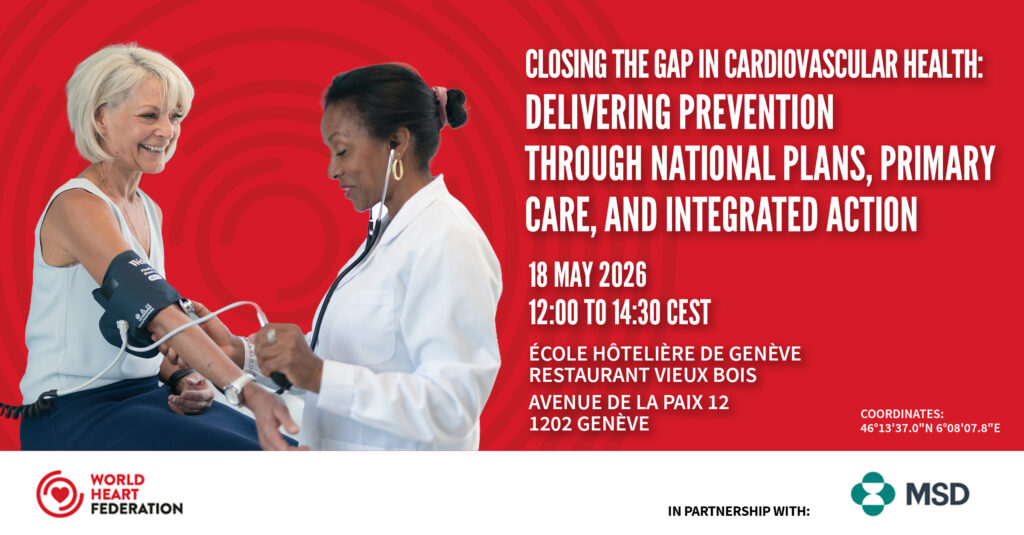
WHF President Professor Jagat Narula’s opening speech at the 79th World Heath Assembly side-event in Geneva on “Closing the Gap in Cardiovascular Health: Delivering Prevention through National Plans, Primary Care, and Integrated Action,” organised by the World Heart Federation and MSD.
My dear colleagues—Good afternoon.
On behalf of the World Heart Federation, it is my profound honor to welcome you to this side event of the Seventy‑Ninth World Health Assembly: Closing the Gap in Cardiovascular Health — Delivering Prevention through National Plans, Primary Care, and Integrated Action.
Allow me to begin with a single number — and with the paradox that lies behind it.
The number is twenty million. Each year, cardiovascular disease takes more than twenty million lives — more than every cancer, every infectious disease, every form of violence and injury combined. It is the leading cause of death on every continent, in every income group, and in nearly every country represented in this room. By the time this hour ends, more than two thousand people will have died from a heart attack or a stroke. Most of them in low‑ and middle‑income countries. Most of them in the prime of life. And most of them from causes we already know how to prevent.
That is the paradox. Four out of every five premature deaths from heart disease and stroke are preventable. We know exactly what to do.
We know that lowering blood pressure cuts the risk of stroke by nearly half and the risk of myocardial infarction by roughly a quarter. We know that reducing LDL cholesterol — with generic statins that cost pennies a day — prevents events at every level of baseline risk, and that newer agents extend that benefit further still. We know that early detection and treatment of diabetes protect the heart, kidneys, eyes, and brain. We know that eliminating industrial trans fats, lowering dietary salt intake, raising tobacco taxes, and cleaning the air we breathe are among the most cost‑effective interventions in public health.
We know that single-pill combination — can deliver, what a generation of fragmented prescribing has failed to achieve. We know that the W-H-O HEARTS package, now implemented in forty-plus countries, has more than doubled hypertension control rates in primary care within just a few years. And we know that every dollar invested in the NCD best buys returns at least seven dollars in averted costs and restored productivity.
The science is settled. The tools are on the shelf. The economic case is unshakable.
And yet — the gap persists.
Of the 1.3 billion adults living with hypertension worldwide, fewer than one in four has it controlled — and in many low‑income countries, fewer than one in ten. Of the patients who would benefit from a statin, the majority — even after surviving a heart attack — will never receive one. Tobacco still kills more than eight million people every year. Ambient and household air pollution together are now linked to nearly five million cardiovascular deaths annually. And rheumatic heart disease — a disease of poverty that high‑income countries eliminated half a century ago — still afflicts 55 million people, most of them children, adolescents, and young women in the regions least able to bear the burden.
This is not a knowledge gap. It is an implementation gap. It is a systems gap. And — let us be honest with one another in this room — it is a gap of political will and of investment.
Too often, our health systems remain organized around the acute event rather than the long arc of risk that precedes it. We build catheterization laboratories before we build primary care. We finance the rescue and underfund the prevention. We measure success in procedures performed rather than in lives saved upstream. Care is fragmented across diseases, across specialties, across levels of service — even though the patient who walks into a clinic with hypertension is, very often, the same patient living with diabetes, with chronic kidney disease, with obesity, with depression, with a life story that cannot be told one diagnosis at a time.
If cardiovascular disease is to be defeated, it will be defeated in primary care.
It is there — in the community clinic, the health post, the pharmacy, the home — that elevated blood pressure can be detected before it becomes a stroke. It is there that cholesterol and glucose can be measured, that absolute cardiovascular risk can be quantified, that medicines can be initiated and adherence supported over the long term. It is there that families can be reached; that women can be screened in pregnancy for the hypertensive and metabolic conditions that will shape their cardiovascular destiny and that of their children; that young people can be protected from the commercial determinants of disease that are already lodging in their arteries.
Primary care is the most cost‑effective line of defense, humanity has ever devised against premature cardiovascular death. We must finance it that way. We must staff it that way. We must equip it — with validated blood pressure devices, with point‑of‑care diagnostics, with a guaranteed package of affordable, quality‑assured essential medicines. And we must measure it that way — by the proportion of our populations whose risk is known, treated, and controlled.
But strengthening primary care alone is not enough if services remain siloed.
The patient does not experience hypertension on Monday, diabetes on Tuesday, or kidney disease on Wednesday. The patient lives all of these at once. Integrated, person-centered care — across the cardiovascular‑kidney‑metabolic spectrum, and reaching into mental health, maternal health, and tuberculosis and HIV programs where the burden converges — is no longer an aspiration. It is a clinical and economic necessity. By linking services across disease areas, by supporting multidisciplinary teams, and by embedding simple digital tools that follow the patient rather than the diagnosis, we can prevent hospitalizations, improve outcomes, and make our systems both more humane and more sustainable.
This is the architecture we need, and national cardiovascular and NCD plans are the blueprint that holds it together. They align ministries, partners, and patients around shared targets. They translate global commitments — SDG 3.4, the WHO Global Action Plan for NCDs, and the Political Declaration on NCDs that Member States have just renewed — into concrete national action. They build the accountability without which good intentions evaporate.
The encouraging news is that momentum is building. More countries than ever are developing dedicated cardiovascular and integrated NCD strategies. New financing mechanisms are emerging. The HEARTS initiative now serves tens of millions of patients. World Heart Federation Roadmaps are being implemented across Latin America, South Asia, and sub-Saharan Africa. Civil society, professional societies, and patient organizations have never been more aligned.
But momentum is not yet an outcome.
And so, the questions before us this afternoon is practical, urgent, and unavoidable:
— How do we translate policy into practice, at the scale and the speed the epidemic demands?
— How do we ensure that screening reaches the half of humanity that is currently invisible to its own health system?
— How do we equip frontline workers — nurses, community health workers, primary care physicians, pharmacists — with the training, the protocols, the medicines, and the data tools they need to manage cardiovascular risk as a routine, measurable activity?
— How do we finance prevention, when ministries of finance still treat it as a cost rather than as the highest‑yielding investment in human capital they will ever make?
— And how do we use the political moment of this World Health Assembly to convert commitment into delivery in the lives of real patients in real clinics?
These are the questions our distinguished panel will take up today. They bring experience from ministries of health, from primary care, from civil society, from research, and from industry — voices that, together, can chart a path from rhetoric to results.
The World Heart Federation stands ready to support every country represented here on that path. Reducing the burden of cardiovascular disease is not a vertical agenda — it is the foundation of healthier populations, stronger health systems, more productive economies, and the universal health coverage to which we have all committed.
Allow me, finally, to thank our partners — and in particular MSD, whose support has made this gathering possible — and each of you who has chosen to spend this hour of the Assembly with us. The fact that this room is full is a measure of where the global agenda is moving.
Nearly twenty million deaths a year, four out of five of them preventable, is not a statistic we can afford to carry forward into another decade. We have the science. We have the tools. We have the policy frameworks. What we now require is delivery — and the courage of national leadership to demand it.
I look forward to a rich and frank discussion.
Thank you.