
79th World Health Assembly – joint event on Addressing Obesity to Reduce the Global Burden of Cardiovascular Disease
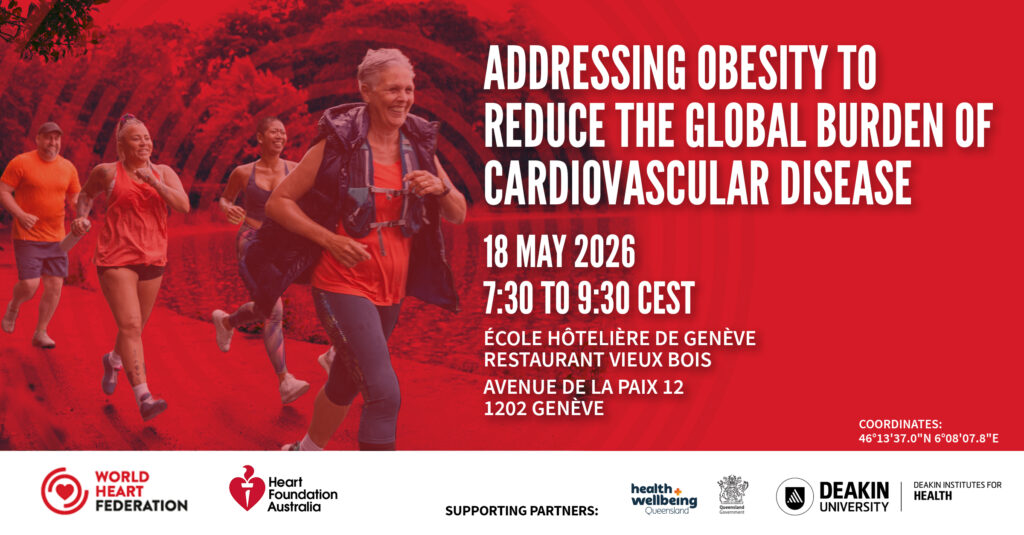
WHF President Professor Jagat Narula’s opening speech at the 79th World Heath Assembly side-event in Geneva on “Addressing Obesity to Reduce the Global Burden of Cardiovascular Disease,” organised by the World Heart Federation and the National Heart Foundation of Australia, with support from Health and Wellbeing Queensland, the Queensland Government, and Deakin University.
Dear colleagues – Good morning.
It is my great honor to welcome you, on behalf of the World Heart Federation, to this side event of the 79th World Health Assembly: Addressing Obesity to Reduce the Global Burden of Cardiovascular Disease.
I want to begin by thanking our co‑hosts, the National Heart Foundation of Australia, whose leadership has made this event possible, and our distinguished panel, and each of you in this room, for choosing to begin your morning at the Assembly with us. The fact that this hall is full, at this hour, on this topic, is itself a measure of how decisively the global health conversation is shifting. We are gathered to confront two epidemics that the world is no longer entitled to treat as separate.
The first is cardiovascular disease — still the leading cause of death and of premature mortality on every continent, claiming more than twenty million lives every year.
The second is obesity — once dismissed as a problem of affluent societies, now a defining global crisis. Today, more than a billion people are living with obesity. Two and a half billion adults — close to half of the world’s adult population — carry excess body weight. Childhood and adolescent obesity have quadrupled since 1990. And for the first time in human history, in 2022, more children and adolescents around the world were affected by obesity than by underweight.
These two epidemics are not parallel. They are convergent. And cardiovascular health is where they meet.
Each year, high body mass index is now estimated to drive more than two and a half million cardiovascular deaths — a figure that has more than doubled over the past three decades, and that is rising fastest in the very low‑ and middle‑income countries with the least capacity to absorb it. Behind each of those numbers is a person — a parent struggling to remain well enough to raise a child; an adolescent already on the path toward a heart attack at the age of forty; a family carrying the financial and emotional weight of a chronic disease that the world had every opportunity to prevent.
Let me state plainly what the science has settled — and what must therefore guide our policy.
Obesity is not a moral failing. It is not the consequence of weak character or of insufficient willpower. As the World Heart Report 2025 made it unambiguous, obesity is a complex, chronic, multifactorial disease — shaped by biology, by the food environment, by the built environment, by social and economic inequities, and very powerfully by the commercial determinants of health: the global marketing of ultra‑processed foods, sugar‑sweetened beverages, and engineered hyper‑palatable products that the human metabolism did not evolve to defend itself against.
And the consequences of that disease are profoundly cardiovascular. Excess adipose tissue is not inert; it is an active endocrine organ that drives hypertension, dyslipidemia, insulin resistance, type 2 diabetes, atrial fibrillation, ischemic heart disease, heart failure — particularly with preserved ejection fraction — chronic kidney disease, and MASLD. These are no longer separate diagnoses. They constitute the cardiovascular–kidney–metabolic syndrome. They share a common biology, they share a common trajectory, and they deserve a common response. For the first time in our professional lifetime, we also have the tools to interrupt that trajectory at scale.
The last three years have transformed what is clinically possible. Incretin‑based therapies — the GLP‑1 and dual GIP/GLP‑1 receptor agonists — have produced sustained weight reductions previously achievable only with surgery. More importantly, the SELECT trial has demonstrated a 20 percent reduction in major adverse cardiovascular events in people living with obesity and established cardiovascular disease, in the absence of diabetes. The STEP‑HFpEF and FLOW programs have extended that benefit into HFpEF and into chronic kidney disease. Bariatric and metabolic surgery, where it is available, reduces cardiovascular events and all‑cause mortality by 30 to 40 percent.
But let us be honest with one another. These therapies are today available almost entirely to those who can afford them, in the countries that can supply them. If we permit this revolution to remain the privilege of the few, we will widen — not narrow — the global cardiovascular gap. Equitable pricing, voluntary licensing, generic and biosimilar pathways, inclusion in essential medicines lists, and integration into primary care must be on this Assembly’s agenda. Innovation that does not reach the patient is innovation that has failed.
And medicines alone, however transformative, will never be sufficient.
We will not pharmacologically treat our way out of an epidemic that is being manufactured upstream. Reducing obesity at population scale demands that we change the environment in which choices are made: front‑of‑pack warning labels that actually work; restrictions on the marketing of unhealthy foods to children; meaningful fiscal measures on sugar‑sweetened beverages and ultra‑processed products; reformulation of the food supply; the elimination of industrial trans fats; school food standards that protect children rather than monetize them; and urban environments that make the physically active life possible for the billions for whom it is currently not.
These are not radical proposals. They are W-H-O best buys. They work. They save lives. They save money. They have been adopted, with measurable success, from Mexico to Chile to the United Kingdom and beyond. What is missing is not evidence. What is missing is political courage in the face of industries whose interests are very different from ours.
For too long, obesity has sat awkwardly at the periphery of cardiovascular prevention — between clinical specialties, between ministries, between programs. Clinical care, nutrition policy, urban planning, education, and commercial regulation have operated in silos, while people living with obesity have continued to encounter stigma in our clinics and barriers to evidence‑based care.
That must end. Obesity must move to the center of our cardiovascular policies, our cardiovascular guidelines, our cardiovascular workforce training, and our cardiovascular advocacy.
Which is precisely why the launch we mark together this morning matters. It is my privilege to recognize the Clinical Consensus Statement on Obesity and Cardiovascular Disease of the National Heart Foundation of Australia, released today at this Assembly. It recognizes obesity as a chronic systemic condition with cardiovascular consequences and provides clinicians with practical, evidence‑based guidance spanning nutrition, physical activity, pharmacotherapy, bariatric and metabolic surgery, and long‑term, multidisciplinary, person-centered care. It is exactly the kind of national clinical leadership the world urgently needs — global evidence translated into something a primary care physician in Sydney, or in São Paulo, or in Nairobi, can use on a Monday morning.
The World Heart Federation stands fully behind this work and behind every country that follows it.
Our position is unequivocal. If we are serious about reducing the global burden of heart disease, stroke, diabetes, and kidney failure, we cannot continue to treat obesity as a separate problem. We must embed obesity prevention and treatment into our cardiovascular strategies. We must guarantee equitable access to effective therapies, old and new. We must confront weight stigma — including within our own profession. We must regulate the commercial determinants of disease with the same seriousness that the world once brought to tobacco. And we must build food, school, and urban environments where the healthy choice is the default— and the easy one.
No single sector, no single institution, no single country can do this alone. International collaboration — across ministries, across professions, across regions, across income groups — is the only currency that will work.
I hope today’s discussion will sharpen that collaboration. I hope it will accelerate stronger policies, stronger clinical leadership, and stronger advocacy at every level — from this Assembly to the bedside.
A billion people living with obesity, two and a half million dying from its cardiovascular consequences each year, and a generation of children whose cardiovascular destiny is being shaped now — that is not a trajectory we can hand on to the next World Health Assembly.
We have the science. We are gaining the tools. What we need is the will.
Thank you, once again, for being here this morning. I look forward to a rich and frank discussion.
Thank you.