
Data availability is crucial to advance scientific knowledge, diagnosis and management of cardiovascular diseases (CVDs). The World Heart Observatory is compiling high quality registries and epidemiological studies on various forms of CVDs from around the world. In the coming days, users will enable to explore the data from these studies through interactive visualisations as well as have access to the original studies and publications.
Keep an eye out on this space and our social media channels for updates.
Details on the INTERASPIRE study are now available below!
Multi-National Studies
The Cohorts Consortium of Latin America and the Caribbean
Study type
Consortium / pooled analysis of population-based cohort studies
Start: 2020
End: Ongoing
Primary objective
To examine the association between cardio-metabolic risk factors (blood pressure, glucose, lipids) and non-fatal and fatal cardiovascular outcomes (stroke, myocardial infarction).
Lead institution
Universidad Peruana Cayetano Heredia, Peru (corresponding author institution); Imperial College London, UK (hosting operations)
Principal investigator
J Jaime Miranda (Universidad Peruana Cayetano Heredia, Peru)
Global Health and Population Project on Access to Care for Cardiometabolic Diseases
Study type
Population-based survey data analysis
Start: 2005
End: 2023
Primary objective
HPACC was established to meet the clear need for answers to key health policy and clinical questions relating to cardiometabolic diseases globally.
Lead institution
Not specified
Principal investigator
Jennifer Manne-Goehler
The International Action on Secondary Prevention through Intervention to Reduce Event
Study type
Observational international survey
Start: 2020
End: 2023
Primary objective
Adults with known cardiovascular conditions, such as coronary heart disease, are at a higher risk for further cardiovascular events. Several secondary prevention guidelines and recommendations have been created, which emphasize evidence-based lifestyle and pharmacological treatment. The World Heart Federation has also recently updated its secondary prevention roadmap, detailing strategies for improving secondary prevention at all levels of the health system.INTERASPIRE is an international study covering 14 countries across the 6 World Health Organization (WHO) regions. It is designed to measure if the guideline standards for secondary prevention and cardiac rehabilitation are being achieved in a timely manner in patients with coronary heart disease.INTERASPIRE demonstrates inadequate and heterogenous international implementation of guideline standards for secondary prevention in the first year after hospitalization for coronary heart disease and shows geographic and sex disparity. Investment aiming to reduce between-country and between-individual variability in secondary prevention will promote equity in global efforts to reduce the burden of coronary heart disease.
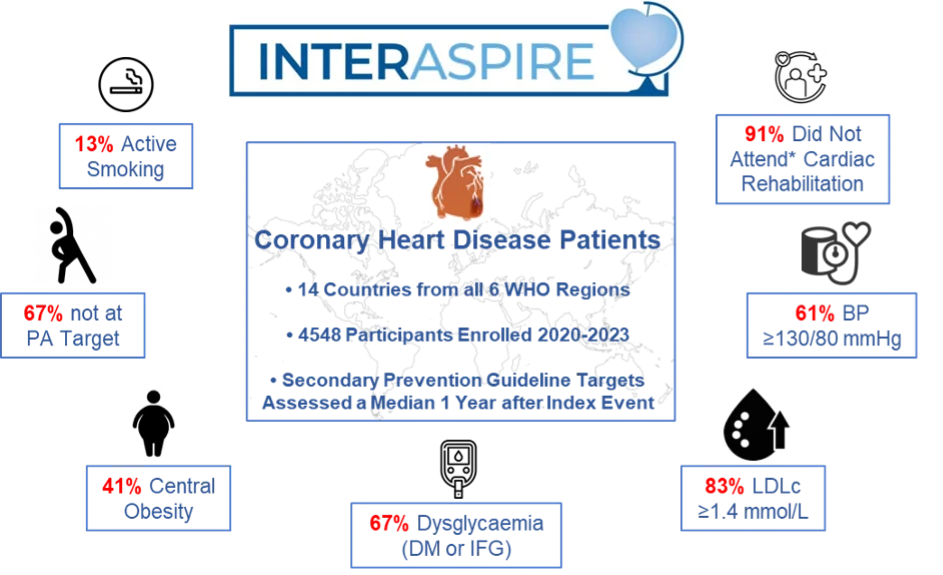 For more information on the study, please refer to the information below. Further interactive data visualizations to be available soon!
Lead institution
Multiple CVD societies
Principal investigator
David Wood
Prospective Urban Rural Epidemiology Study
Study type
Observational prospective cohort study
Start: 2002
End: 2030
Primary objective
To examine the relationship between societal influences and prevalence of risk factors and chronic noncommunicable diseases measured at baseline. Societal determinants are measured by an index of measures from four domains: built environment, food and nutrition policy, psychosocial and socioeconomic factors, and tobacco. The study also examines how these societal determinants influence the incidence of chronic noncommunicable disease events and changes in rates of selected risk factors over time.
Lead institution
Population Health Research Institute (PHRI), McMaster University, Hamilton Health Sciences
Principal investigator
Salim Yusuf
Rheumatic Heart Disease Registry
Study type
Observational registry
Start: 2010
End: 2016
Primary objective
To document the clinical and echocardiographic characteristics of patients at presentation and to document disease progression and treatment practices over a two-year follow-up, with particular reference to adherence to secondary prophylaxis and oral anticoagulation regimens.
Lead institution
Population Health Research Institute (PHRI)
Principal investigator
Ganesan Karthikeyan
BuRden of ChAgas dISEase in the contemporary world
Study type
Meta-analysis
Start: Not specified
End: Not specified
Primary objective
The RAISE project aims to reassess the burden of Chagas disease and Chagas disease cardiomyopathy. Using a multidimensional approach, the project seeks to refine estimates of Chagas disease-related deaths, conduct systematic reviews on seroprevalence and prevalence of clinical forms, enhance existing modeling frameworks, and calculate the global economic burden, including healthcare expenditures and access to services.
Lead institution
Universidade Federal de Minas Gerais, Brazil in collaboration with World Heart Federation.
Principal investigator
Antonio Ribeiro